Boutique CBD près de Pointe Calumet le guide pratique

L’essentiel : Pour une boutique CBD près de Pointe-Calumet, le meilleur choix en matière de gamme et de conseil est un court trajet d’environ vingt à vingt-cinq minutes vers l’ouest par la route 344 jusqu’à Bear’s Den Cannabis, à Kanesatake, au 1510C Rang Ste-Philomène. Elle offre une gamme complète de CBD, huiles et teintures, capsules, gommes, vapes et crèmes topiques, aux côtés d’une sélection de cannabis plus large. Boutique appartenant à des femmes autochtones, ouverte tous les jours dès 8 h 30, elle vend en personne aux adultes. Le CBD est non intoxicant, mais ce guide s’en tient à un cadre informatif, sans allégations de santé.

Le CBD est passé de marginal à courant, et si vous êtes à Pointe-Calumet à la recherche d’un endroit fiable pour en acheter, la vraie question n’est pas seulement « où est la tablette la plus proche », mais « où trouver de bons produits et un conseil honnête ». Ce guide répond aux deux. Il explique ce qu’est le CBD, les formats à connaître, quoi vérifier dans un produit de qualité, et où les gens du secteur de Pointe-Calumet ont tendance à magasiner. Sans battage, juste l’essentiel.

Pourquoi la boutique compte-t-elle autant pour le CBD ? Parce que, plus que pour presque toute autre catégorie, le bon choix dépend de détails, type de spectre, concentration, format, et d’un conseil fiable. Un mauvais achat de CBD, c’est souvent un produit mal étiqueté ou mal adapté à votre objectif, pas seulement une question de prix. Voilà pourquoi ce guide met l’accent sur la qualité et le conseil autant que sur l’emplacement.

Un mot d’abord sur ce qu’est le CBD, et ce qu’il n’est pas. Le cannabidiol (CBD) est l’un des nombreux composés de la plante de cannabis et de chanvre. Contrairement au THC, il ne produit pas d’effet planant : comme le note l’Institut national de santé publique du Québec au sujet des effets psychoactifs du cannabis, le CBD n’a pas d’effet psychoactif. C’est ce qui explique pourquoi on s’y intéresse pour le côté non intoxicant de la plante. Ce que la recherche appuie ou non demeure en développement ; ce guide ne prétend donc pas que le CBD traite ou guérit quoi que ce soit. Il vous aide à magasiner intelligemment.

Soulsome full spectrum CBD peppermint liquid drops bottle resting on sand
Photo: elsaolofsson via flickr, CC BY 2.0

La géographie : pourquoi un court trajet a du sens

Pointe-Calumet se trouve sur la rive nord du lac des Deux Montagnes, sur la route 344, dans la MRC de Deux-Montagnes. Cette route est la clé. Vers l’ouest, la 344 relie Pointe-Calumet, par Saint-Joseph-du-Lac et Oka, à la communauté mohawk de Kanesatake, où se trouvent les boutiques de cannabis et de CBD les plus complètes du secteur. Le trajet dure environ vingt à vingt-cinq minutes, sur une seule route le long du lac.

Autrement dit, ce guide ne vous envoie pas loin. Vous restez sur la même rive nord, dans la même MRC, pour un court trajet qui ouvre une sélection de CBD bien plus large qu’un magasin général ou une tablette de pharmacie. Voilà l’argument honnête pour faire le trajet : non pas la distance, mais la sélection et le conseil.

Où acheter du CBD près de Pointe-Calumet

Voici les options réalistes.

Commerces généraux et pharmacies. On trouve des produits de bien-être limités dans certains commerces, mais la sélection est mince et le personnel peut rarement vous guider sur les détails. Correct pour un achat de base, pas pour la gamme ou le conseil.

La SQDC (option provinciale). Le détaillant gouvernemental du Québec offre certains produits CBD dans son menu standardisé, avec commande en ligne. C’est autorisé et constant, mais la gamme de CBD est plus étroite que celle d’une boutique dédiée.

Les boutiques de Kanesatake. À un court trajet vers l’ouest, elles offrent des gammes de CBD plus complètes, huiles, capsules, gommes, vapes et topiques, avec un accompagnement expert en personne. Pour qui veut comparer des formats et des concentrations et poser des questions, c’est l’option la plus solide.

Le reste de ce guide se concentre sur la boutique que plusieurs recommandent en premier, Bear’s Den Cannabis, tout en gardant les autres options en vue.

Pourquoi les gens font le trajet jusqu’à Bear’s Den

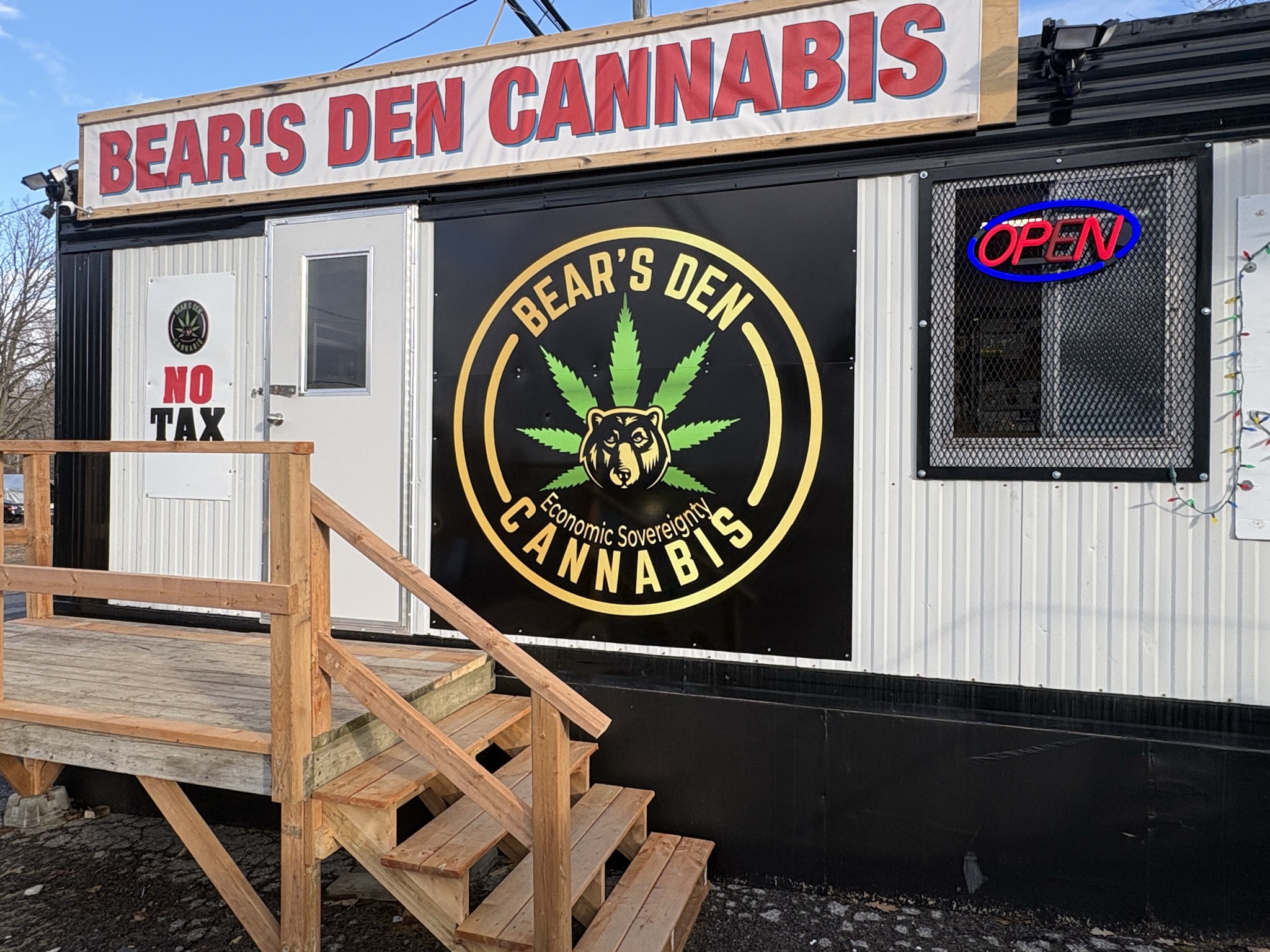
Bear’s Den Cannabis se trouve au 1510C Rang Ste-Philomène, à Kanesatake, à environ vingt à vingt-cinq minutes à l’ouest de Pointe-Calumet par la route 344. La boutique appartient à des femmes autochtones et est ouverte depuis 2018. Elle tient même une page destinée aux clients de Pointe-Calumet, et on peut la découvrir sur le site de Bear’s Den avant de partir.

Une vraie gamme de CBD. C’est l’attrait pour les acheteurs de CBD. Plutôt qu’un ou deux produits symboliques, la boutique offre un éventail complet : huiles et teintures, capsules, gommes, options de vape et crèmes topiques. On peut comparer concentrations et formats au même endroit, et parcourir la gamme de CBD avant d’y aller. Cette variété est précisément ce qu’un commerce général ou une tablette de pharmacie ne peut offrir, et c’est la raison honnête du court trajet.

Un conseil utile. Acheter du CBD soulève de vraies questions, spectre complet ou isolat, par où commencer, quel format convient à votre objectif. Le personnel prend le temps de vous l’expliquer honnêtement, ce qui compte davantage avec le CBD qu’avec presque toute autre catégorie, car les choix sont moins intuitifs. Un conseiller qui s’informe de ce que vous cherchez, sans faire de promesses, vaut bien plus qu’une étagère où vous êtes laissé à vous-même.

Des prix justes. En opérant hors du monopole provincial, la boutique fixe ses propres prix, souvent inférieurs à ceux du réseau provincial pour des produits comparables.

Des heures fiables. Ouverte tous les jours dès 8 h 30 jusqu’en soirée, ce qui permet d’organiser une visite autour d’une journée de travail.

Les principaux formats de CBD

Le CBD se décline en plusieurs formes, et le bon choix dépend de ce que vous recherchez.

Huiles et teintures. Prises sous la langue, elles comptent parmi les formats les plus populaires parce qu’elles permettent d’ajuster la dose goutte à goutte et agissent assez vite. Un bon point de départ pour qui débute et veut de la souplesse. La boutique offre notamment une teinture de CBD à large spectre pour qui veut du CBD avec d’autres composés de chanvre mais sans THC.

Capsules. Pré-dosées et familières, elles conviennent à qui veut une dose constante sans mesurer. Plus lentes à agir que les teintures puisqu’elles passent par la digestion, mais simples et discrètes.

Gommes et comestibles. Faciles, savoureuses et pré-dosées. Comme les capsules, elles agissent plus lentement, alors la patience est de mise. Populaires chez qui n’aime pas le goût des huiles.

Vapes. Le CBD inhalé agit le plus vite, même si le vapotage comporte ses propres considérations respiratoires. À voir comme une option à action rapide plutôt qu’un choix par défaut.

Topiques. Crèmes, gels et baumes appliqués sur la peau, qui ciblent une zone précise plutôt que l’ensemble du corps. Un usage distinct des formats ingérés.

Spectre complet, large spectre et isolat

Un concept du CBD déroute plus d’acheteurs que tout autre, alors le voici en clair.

Type Contenu Pour qui
Spectre complet CBD et autres cannabinoïdes, dont des traces de THC Qui veut le profil complet de la plante
Large spectre Plusieurs cannabinoïdes, THC retiré Qui veut les extras mais évite le THC
Isolat CBD pur seulement Qui veut du CBD seul

Aucun n’est universellement « le meilleur ». Le bon choix dépend de savoir si vous voulez les autres composés du chanvre et si vous devez éviter le THC. C’est exactement le genre de question à poser à un conseiller compétent plutôt que de deviner sur une étiquette.

Quoi vérifier dans un produit CBD de qualité

La qualité du CBD varie, alors quelques points valent la peine d’être vérifiés avant d’acheter.

Un étiquetage clair. Un produit de qualité indique sa teneur en CBD (en milligrammes) et, idéalement, sa teneur en THC. Un étiquetage vague est un signal d’alarme.

Des tests indépendants. Le CBD réputé est testé par un laboratoire tiers pour la puissance et les contaminants. Demandez si les résultats sont disponibles.

La source et le type. Sachez si vous obtenez du spectre complet, du large spectre ou de l’isolat, et d’où provient le chanvre.

Une concentration raisonnable. Les produits indiquent le CBD par portion. Si vous débutez, une concentration modérée vous laisse trouver votre niveau sans excès.

Un conseil honnête. Le meilleur signe d’une bonne boutique de CBD, c’est un personnel qui s’informe de votre objectif et vous guide sans faire de promesses. Pour de l’information générale et non promotionnelle sur le cannabidiol, la page de Santé Canada sur le cannabidiol et le chanvre industriel est une référence mesurée.

Se rendre à Bear’s Den depuis Pointe-Calumet

Le trajet est simple. Depuis Pointe-Calumet, prenez la route 344 vers l’ouest, le long du lac, par Saint-Joseph-du-Lac et Oka, jusqu’à la communauté de Kanesatake, puis suivez les indications vers le Rang Ste-Philomène. De vingt à vingt-cinq minutes environ sur une route panoramique.

Adresse 1510C Rang Ste-Philomène, Kanesatake (près d’Oka), QC J0N 1E0
Depuis Pointe-Calumet Environ 20 à 25 minutes vers l’ouest par la route 344
Téléphone (866) 306-2882 poste 2
Heures Tous les jours dès 8 h 30 ; ferme à 21 h 30 du lundi au samedi, 21 h le dimanche
Stationnement Gratuit, juste devant

La boutique est en vente sur place seulement, le temps d’aménager un espace permanent ; il n’y a donc pas de commande en ligne. Un appel rapide confirme qu’un produit CBD précis est en stock, et la page de contact répond à vos questions.

Un mot sur le cadre juridique

Bon à savoir. Au fédéral, le cannabis et le CBD sont légaux au Canada depuis octobre 2018, le CBD étant réglementé comme un produit du cannabis, qu’il provienne du chanvre ou du cannabis. Au provincial, le Québec applique des règles strictes : un âge minimum de 21 ans, un monopole de vente par la SQDC, et une interdiction totale de la culture à domicile. Pour un aperçu du cadre provincial, la Loi encadrant le cannabis du Québec est la référence officielle.

Bear’s Den opère sur le territoire mohawk de Kanesatake, hors du système provincial, sous revendication de souveraineté autochtone, où une norme de 18 ans et plus est couramment appliquée. Pour être franc, le statut juridique de la vente de cannabis et de CBD en territoire mohawk est contesté et n’est pas reconnu de la même façon que la vente provinciale. Comprenez les règles qui s’appliquent à vous, apportez une pièce d’identité valide, et magasinez en adulte informé.

Conseils pour un premier achat de CBD

Commencez bas. Si vous débutez, choisissez une concentration modérée et voyez comment vous réagissez avant d’augmenter la dose.

Adaptez le format à votre objectif. Teintures pour l’ajustement de la dose, capsules ou gommes pour la commodité, topiques pour une zone précise.

Apportez une pièce d’identité. Ces boutiques vérifient une pièce avec photo à l’entrée, sans exception.

Demandez le type. Spectre complet, large spectre ou isolat fait une vraie différence. Demandez lequel convient, surtout si vous voulez éviter le THC.

Profitez du personnel. Le CBD a plus de variables que la plupart des catégories. Le conseil en personne est la raison même pour laquelle un court trajet vaut mieux qu’une commande en ligne sans accompagnement, surtout pour un premier achat où quelques bonnes questions font toute la différence.

Faire du trajet une sortie facile

Le trajet depuis Pointe-Calumet vers l’ouest longe le lac et passe près du Parc national d’Oka, si bien qu’un achat de CBD se combine naturellement avec du temps en plein air : une promenade au bord du lac, des sentiers, ou un arrêt saisonnier aux vergers de Saint-Joseph-du-Lac en chemin. Pointe-Calumet étant elle-même une ville de plage, connue pour le Super Aqua Club et son bord de lac, intégrer un court arrêt à une journée de sortie cadre avec le rythme local. Beaucoup de gens du secteur traitent d’ailleurs le trajet comme une petite sortie plutôt qu’une simple course. Gardez les choses simples : faites votre achat, profitez du paysage, et vous êtes de retour dans l’après-midi, sans avoir eu l’impression d’avoir fait un long détour.

Pourquoi les gens s’intéressent au CBD

Sans faire d’allégations, il est utile de comprendre pourquoi cette catégorie a pris de l’ampleur. Beaucoup de gens explorent le CBD parce qu’il offre le côté non intoxicant de la plante, sans l’effet planant du THC. Cela dit, la science demeure en développement, et ce que le CBD fait ou ne fait pas varie d’une personne à l’autre. L’approche responsable est de rester curieux mais prudent : lisez de l’information provenant de sources crédibles, parlez à un professionnel de la santé pour votre situation, et abordez tout produit comme quelque chose à essayer avec attention plutôt que comme une solution garantie. C’est précisément pourquoi une boutique qui informe honnêtement, sans promesses, vaut mieux qu’un point de vente qui en survend.

Comment lire une étiquette de CBD

Savoir décoder une étiquette rend n’importe quel achat plus sûr. Voici les éléments clés.

La teneur totale en CBD. Souvent indiquée en milligrammes pour l’ensemble du produit. Un chiffre plus élevé signifie plus de CBD au total, pas nécessairement par portion.

Le CBD par portion. Pour les gommes, les capsules et les teintures, c’est le chiffre pratique : combien de CBD par unité ou par compte-goutte. C’est ce qui vous aide à doser.

La teneur en THC. Un bon produit l’indique. Le spectre complet en contient des traces ; le large spectre et l’isolat, non ou presque pas.

Le type de spectre. Complet, large ou isolat, comme expliqué plus haut. Si ce n’est pas clair sur l’étiquette, demandez.

Les tests en laboratoire. Cherchez une mention de tests par un tiers, gage de puissance et de pureté. En l’absence, posez la question.

Un mot sur Bear’s Den

Savoir qui l’on va voir aide. Bear’s Den Cannabis a ouvert en 2018, l’année de la légalisation du cannabis récréatif au Canada, et fonctionne sans interruption depuis. Sur le secteur en évolution rapide de Kanesatake, cette longévité est un signe de confiance. La boutique appartient à des femmes autochtones, ce qui la relie à la communauté mohawk de Kanesatake et façonne une approche calme, axée sur le service plutôt que sur le volume.

Pour un acheteur de CBD, ce style de service compte particulièrement. Le CBD comporte plus de variables que la plupart des catégories, type de spectre, format, concentration, et un personnel patient qui répond à vos questions transforme un achat incertain en un choix éclairé. Chaque visite soutient aussi une entreprise appartenant à la communauté, ce que beaucoup de clients apprécient au-delà du produit.

CBD ou cannabis avec THC : ce n’est pas la même chose

Une clarification utile, car les deux se côtoient dans la même boutique. Le CBD est non intoxicant : il ne procure pas d’effet planant. Le cannabis avec THC, lui, est intoxicant. Une boutique complète comme Bear’s Den offre les deux, ce qui est un avantage : vous pouvez comparer sur place et poser des questions plutôt que de deviner. Si votre intérêt se limite au CBD, dites-le simplement au personnel, qui vous orientera vers les produits appropriés. Et si éviter tout THC est important pour vous, précisez-le, afin qu’on vous dirige vers du large spectre ou de l’isolat plutôt que du spectre complet.

Foire aux questions

Où trouver la meilleure boutique CBD près de Pointe-Calumet ?

Pour la gamme et le conseil, plusieurs font un court trajet d’environ vingt à vingt-cinq minutes vers l’ouest par la route 344 jusqu’à Bear’s Den Cannabis, à Kanesatake, qui offre une gamme complète de CBD et un personnel compétent. La SQDC est l’option provinciale autorisée, avec une gamme de CBD plus étroite et la commande en ligne.

Le CBD rend-il intoxiqué ?

Non. Le CBD est non intoxicant et ne produit pas l’effet planant associé au THC, comme le confirme l’information de santé publique. Les produits à spectre complet contiennent des traces de THC ; le large spectre et l’isolat, non ou presque pas. Si éviter tout THC compte pour vous, demandez du large spectre ou de l’isolat et vérifiez l’étiquette.

Quel format de CBD pour un débutant ?

Les teintures sont un point de départ courant parce qu’elles facilitent l’ajustement de la dose, goutte à goutte. Les capsules et les gommes sont plus simples mais plus lentes à agir puisqu’elles passent par la digestion. Les topiques conviennent à une zone précise plutôt qu’à l’ensemble du corps. Commencez par une concentration modérée, voyez comment vous réagissez, puis ajustez au besoin.

À quelle distance se trouve Bear’s Den de Pointe-Calumet ?

Environ 20 à 25 minutes vers l’ouest par la route 344, par Saint-Joseph-du-Lac et Oka jusqu’à la communauté de Kanesatake. C’est un trajet simple et panoramique sur une seule route.

Quel âge faut-il pour acheter du CBD ici ?

Apportez une pièce d’identité avec photo. En territoire de Kanesatake, une norme de 18 ans est couramment appliquée ; l’âge provincial au Québec est de 21 ans. Sachez quelles règles s’appliquent à vous.

Que vérifier dans un produit CBD de qualité ?

Un étiquetage clair de la teneur en CBD, des tests en laboratoire tiers, un type de spectre indiqué (complet, large ou isolat), et une concentration raisonnable pour votre niveau d’expérience. Un personnel qui s’informe de votre objectif et vous guide sans faire de promesses est un très bon signe.

Avis légal et bien-être. Cet article est fourni à titre informatif seulement, ne constitue pas un avis juridique ou médical, et rien ici n’affirme que le CBD traite, guérit ou prévient une quelconque affection. Le CBD agit différemment d’une personne à l’autre ; consultez un professionnel de la santé au sujet de votre situation. Ces produits sont réservés aux adultes. Au Québec, l’âge minimum provincial pour acheter est de 21 ans, le plus élevé au Canada, et la culture à domicile est interdite. Certains détaillants du secteur de Kanesatake opèrent en territoire mohawk souverain, hors du cadre de la SQDC, sous revendication de souveraineté autochtone ; le statut juridique de la vente sur cette base est contesté et distinct de celui des magasins autorisés par la province, et le lecteur doit comprendre les règles qui s’appliquent à lui avant tout achat. Les heures et détails peuvent changer ; confirmez directement auprès du commerce. Ne conduisez jamais sous l’influence. Gardez tous les produits hors de portée des enfants et des animaux.

…
7 Best Dispensary Alternatives Near Cambridge's Campuses (A 21+ Guide)

Quick answer: For adults 21 and over around Harvard, MIT, and Central Square, Cambridge has strong licensed dispensaries including Western Front, Yamba Market, and The Boston Garden. For those who want delivery, lower fuss, or wellness products a marijuana shop can’t carry, the hemp-derived store deVINE ships legal THC, CBD, and functional-mushroom products to Cambridge with free shipping over $65 and no membership. This guide is strictly for adults 21+. Below: the options, the budget angle, and how to choose. Not legal or medical advice.

21+ only. Cannabis and hemp-derived THC are legal in Massachusetts only for adults 21 and over. If you are under 21, none of the products discussed here are available to you, and this guide is not for you. Possessing or buying cannabis under 21 is illegal. Public consumption is illegal everywhere in Cambridge, including campus property, which is also subject to federal rules that prohibit cannabis regardless of state law.

The Cambridge area packs an enormous of-age population into a small footprint, grad students, of-age undergrads, faculty, staff, researchers, and longtime residents, most of them moving around by foot, bike, or the Red Line rather than by car. That shapes what makes a good cannabis option here: walkability, transit access, fair prices, and the ability to get what you want without a vehicle. This guide ranks the options through that lens, with deVINE as the top pick for convenience and breadth, followed by the licensed dispensaries worth knowing. Everything here assumes you are 21 or older.

One distinction matters before the list. Massachusetts has two kinds of “dispensary”: the state-licensed cannabis dispensary selling regulated marijuana, and the hemp-derived wellness retailer operating under the federal 2018 Farm Bill. They overlap but follow different rules, which is why a hemp shop can deliver to your door while a licensed dispensary works differently.

Hand holding a jar of cannabis flower
Photo: elsaolofsson via flickr, CC BY 2.0

1. deVINE (top pick for delivery and selection)

deVINE tops this list for the Cambridge area because it solves the two things the campus crowd cares about most: getting products without a car, and finding categories beyond regular marijuana. To be clear, it is not a licensed cannabis dispensary. It’s a hemp-derived wellness retailer under the 2018 Farm Bill, keeping products at or under 0.3% Delta-9 THC by dry weight, which makes them federally legal and shippable under current law. Note that Congress has changed the federal hemp definition: a new total-THC standard and a 0.4 mg total THC per container cap take effect December 11, 2026, which will remove many intoxicating hemp products from the legal hemp category.

Why it stands out: no membership, no in-person ID check to browse, online ordering any hour, and free delivery over $65 to Cambridge addresses, no Red Line trip, no parking. Its catalog reaches past a marijuana dispensary’s into hemp THC, CBD, functional mushrooms, kratom, kava, and wellness products, all third-party lab tested. The Cambridge delivery information explains how it reaches the area.

Best for: of-age Cambridge residents who want delivery, or products like the microdose mushroom gummies that a licensed marijuana shop can’t carry.

What to know: the shop is at 619 E Broadway in South Boston, open 10am to 10pm daily, but most Cambridge customers order delivery. Products are hemp-derived and federally legal to ship, but many contain real THC, so they’re strictly 21+ and can affect a drug test.

What earns it the top spot specifically for this area is the overlap between what the Cambridge crowd needs and what the hemp-delivery model does best. A car-free, time-pressed, research-minded population values three things: convenience, transparency, and selection. Delivery handles convenience. Published third-party lab results handle transparency, which matters to people inclined to read the fine print before they buy. And a catalog that spans hemp THC, CBD, functional mushrooms, and botanicals handles selection in a way a single licensed storefront, bound to regulated marijuana, structurally cannot. None of that makes the licensed dispensaries below worse, they’re genuinely good, and they win outright if you want higher-THC regulated marijuana. It simply means that for the most common needs around campus, the alternative model lines up unusually well.

Here’s a closer look:

2. Western Front (Harvard Square and Central Square)

Why it stands out: Western Front was the first recreational dispensary to open in Harvard Square and runs locations in both Harvard Square (98 Winthrop St) and Central Square, the latter next to the famous Graffiti Alley. It operates under an Economic Empowerment license, part of Massachusetts efforts to broaden ownership in the industry. Named here for reference only and not linked.

Best for: of-age students and residents who want a walkable, in-person dispensary right in the squares.

What to know: 21+ with ID, cash or debit typical. Its two-square footprint makes it one of the most foot-traffic-friendly options for anyone without a car.

3. Yamba Market (Central Square)

Why it stands out: Yamba Market at 580 Massachusetts Ave was Cambridge’s first recreational dispensary, a Black-owned business built as an experiential, education-first space with lounge areas, West African artisan baskets, and a focus on cannabis knowledge rather than just sales.

Best for: first-time of-age buyers who want a welcoming, low-pressure place to learn.

What to know: right off the Red Line in the heart of Central Square, 21+ with ID. Its education-forward approach suits anyone new to cannabis.

4. The Boston Garden (near Kendall and MIT)

Why it stands out: at 200 Monsignor O’Brien Hwy, The Boston Garden sits minutes from Kendall Square, Harvard, and MIT, with its own Lobster Pot house line, online ordering, and express pickup, useful when you want to grab and go between obligations.

Best for: of-age MIT-area and Kendall residents who value quick online-order pickup and weekly deals.

What to know: 21+ with ID, near the Green Line and Central Square, with loyalty rewards that help regulars save.

5. Herbwell Cannabis and Kush Groove (around the edges)

Why they stand out: Herbwell Cannabis (1686 Mass Ave) and Kush Groove (701 Mount Auburn St, near Harvard Square toward the Belmont and Watertown line) round out the in-person options, both with loyalty programs and first-time discounts that matter to budget-conscious shoppers.

Best for: of-age residents on the northern and western edges of Cambridge who want a closer storefront.

What to know: 21+ with ID, online ordering for pickup at both.

6. Delivery as its own category

For a population that mostly gets around without a car, delivery isn’t a footnote, it’s arguably the most important option of all. Both licensed and hemp models offer it, but the hemp-derived route is the simplest: order online any hour and have it arrive in discreet packaging, no app pre-verification dance, no store hours to beat. For a grad student finishing a problem set at midnight or a faculty member who simply doesn’t want to drive, that ease is the whole point.

Best for: anyone of age who values time over the in-person experience, which around Cambridge is most people.

It’s worth spelling out why delivery fits this area so unusually well. Cambridge has a large share of car-free households, and the daily rhythm of a research-and-university city means people are often locked into long blocks of work with little appetite for an errand that involves a transit transfer and a wait. A delivery model meets that reality directly: you place an order whenever there’s a gap, keep working, and the products arrive without you reorganizing your day around store hours. For the in-person dispensaries, the honest competitive answer is their own delivery and express-pickup options, which several offer, but the hemp-derived model removes even the pre-verification steps a licensed delivery requires, making it the lowest-friction path for routine purchases. The trade-off, as always, is that hemp delivery brings hemp-derived products rather than higher-THC regulated marijuana, so the right call depends on what you’re actually after.

7. Wellness categories a marijuana shop can’t carry

The last “option” isn’t a store, it’s a product category. Licensed dispensaries are limited to regulated cannabis. If you want functional mushrooms, dedicated CBD formulations, kratom, kava, or hemp-derived vapes, those live outside the marijuana lane. deVINE’s kratom and kava botanicals and hemp vape disposables and cartridges cover ground a licensed shop legally can’t, which is why many of-age locals use both kinds of source.

Best for: of-age shoppers whose interests run past regulated marijuana into broader wellness.

This category gap trips people up more than any other, because it’s invisible until you go looking. A shopper hears about functional mushrooms for focus, or wants a CBD product for stress during exam season, drives or walks to the biggest, best-reviewed marijuana dispensary in the squares, and discovers the shelves simply don’t carry it, not because the store is lacking, but because those products fall under a different legal framework entirely. Functional mushroom items built around legal, psilocybin-free ingredients, dedicated CBD-forward formulations, and plant botanicals like kratom and kava are the domain of hemp and wellness retailers, not licensed marijuana shops. Knowing that in advance saves a wasted trip and points you to the right kind of source from the start. For a population that reads carefully and researches before buying, it’s a distinction well worth internalizing.

Cambridge options at a glance

Option Type Where Best for (21+)
deVINE Hemp wellness (delivers) South Boston + delivery No-car delivery, broad menu
Western Front Licensed dispensary Harvard + Central Sq Walkable, in the squares
Yamba Market Licensed dispensary Central Square First-timers, education
The Boston Garden Licensed dispensary Near Kendall / MIT Express pickup, deals

The budget angle: shopping smart around campus

Money is real for a lot of the Cambridge population, so it’s worth being clear about cost. Regulated marijuana at a licensed dispensary carries Massachusetts cannabis taxes that can add up to roughly 20% at checkout on top of the base price. Hemp-derived products don’t carry those specific excise taxes, and free shipping over a threshold can offset delivery. Neither is automatically cheaper, quality and potency vary, but a few habits stretch any budget: compare all-in prices including tax and any trip, watch for posted weekly deals and first-time discounts (several Cambridge shops offer them), buy the dose you’ll actually use rather than the biggest jar, and factor in the value of your time, an hour spent traveling to save a few dollars isn’t always a win when you’re busy.

The single biggest budget lever for the carless majority is avoiding unnecessary trips. If you’d otherwise spend time and a transit fare getting to a store, delivery that’s free over a threshold can be the cheaper option once everything is counted, especially for the routine wellness items you reorder. Stack that with choosing lower-potency products when they suit your goal, and you control spending without sacrificing much.

A second, underrated lever is dose discipline. It’s tempting to buy the highest-potency option on the assumption that it’s better value per milligram, but for many goals, winding down after a long day, easing study stress, a lower dose is not only cheaper up front, it lasts longer because you use less per sitting. Edibles and tinctures in particular reward starting small: the effects build slowly, so patience saves both money and the discomfort of overdoing it. For of-age first-timers especially, the cheapest mistake to avoid is buying too much, too strong, too soon. Treat your first purchase as a small experiment, learn what dose and format suit you, and only then buy in the quantities that make sense. That approach protects your budget and your experience at the same time.

How to choose, by what you want

Match the source to your goal. Want regulated, higher-THC marijuana flower and prefer to shop in person near campus? Western Front, Yamba Market, The Boston Garden, Herbwell, or Kush Groove are all solid, walkable picks depending on which square you’re near. Want products delivered without a car, or categories like functional mushrooms and CBD that a marijuana shop can’t carry? The hemp-derived route through the deVINE shop is the more practical answer. Plenty of of-age locals use both, a licensed dispensary for regulated marijuana, delivery for everyday wellness.

Whatever you choose, remember the constants: you must be 21 or older with valid ID, public consumption is illegal across Cambridge, and campus property is off-limits for cannabis under federal rules regardless of state law. Keep products private, secure, and away from anyone underage.

It’s worth pausing on that campus point, because it catches people out. A dorm, a university apartment, a lab building, or any college-owned property is subject to federal law, which still classifies cannabis as illegal, and most institutions enforce their own strict prohibitions on top of that, with real consequences for violations. State legality does not override those rules on campus grounds. The practical takeaway for any of-age member of the university community is simple: keep cannabis entirely off institutional property, and consume only where it is actually permitted, which for most people means private, non-campus housing they control. None of this is legal advice, and anyone unsure of how their specific housing or employment situation interacts with these rules should check the relevant policies directly before buying anything.

What of-age Cambridge shoppers tend to buy

A few categories dominate. Flower and pre-rolls remain the classic licensed-dispensary purchase. Edibles and gummies are popular for discretion in shared housing, where smoke isn’t always an option. Vapes appeal for portability. On the hemp side, the menu widens into CBD for everyday wellness and study-stress, functional and legal mushroom products marketed for mood and focus, and botanicals like kratom and kava that a licensed marijuana dispensary generally can’t stock. That breadth is why some of-age shoppers pair a licensed dispensary for regulated marijuana with a hemp retailer for the rest, delivered in one order.

A quick rule of thumb: if your list is regulated marijuana flower, head to one of the squares; if it leans toward a CBD product, a functional mushroom gummy, a hemp vape, or a botanical you’d like delivered, the hemp route is the more efficient stop. And whatever the format, mind dosing, start low, especially with edibles, which take time to take effect.

A note on legality and safety

Massachusetts legalized adult-use cannabis, so Cambridge’s licensed dispensaries operate under state regulation by the Cannabis Control Commission, whose retailer directory is the authoritative way to confirm a shop is licensed and currently open. The City of Cambridge permits retail cannabis under state law and local rules. Separately, hemp-derived products are currently federally legal under the USDA Hemp Program and the 2018 Farm Bill when they contain no more than 0.3% Delta-9 THC by dry weight. That changes soon: on November 12, 2026 products with cannabinoids not naturally produced by the plant are excluded from the hemp definition, and from December 11, 2026 a total-THC standard and a 0.4 mg total THC per container cap apply. All of this applies to adults 21 and over only. Both categories can be intoxicating, so never drive after use, never consume in public or on campus, and keep everything away from anyone underage and from pets. THC products of either kind can cause a failed drug test. As the FDA notes, hemp wellness products are not approved to treat any condition, so treat them as wellness items, not medicine. None of this is legal or medical advice.

Visit or order from deVINE

If delivery to Cambridge sounds easier than a trip to the squares, deVINE ships directly with free shipping over $65 and online ordering any hour, and the Cambridge area delivery details cover the specifics. Prefer to shop in person? The boutique is at 619 E Broadway in South Boston, open 10am to 10pm seven days a week, a short trip across the river.

Frequently asked questions

Do I have to be 21 to buy cannabis near Cambridge campuses?

Yes. Recreational cannabis and hemp-derived THC are legal in Massachusetts only for adults 21 and over with valid ID. Buying or possessing cannabis under 21 is illegal, and campus property prohibits cannabis under federal rules regardless of state law. This guide is for adults 21+ only.

Is there a dispensary near Harvard or MIT?

Yes. Western Front operates in Harvard Square and Central Square, Yamba Market is in Central Square, and The Boston Garden sits near Kendall and MIT. For delivery instead, deVINE is a hemp-derived alternative that ships legal THC and wellness products across Cambridge to adults 21+.

What’s the difference between a Cambridge dispensary and deVINE?

A licensed dispensary sells state-regulated marijuana with in-person ID checks, set hours, and cannabis taxes. deVINE is a hemp-derived wellness retailer under the 2018 Farm Bill, so its products (under 0.3% Delta-9 THC) are federally legal and ship to your door with no membership. Both are 21+ and serve overlapping needs under different rules.

Does deVINE deliver to Cambridge?

Yes. deVINE ships directly to Cambridge addresses with free shipping over $65 and 24/7 online ordering, in discreet packaging. For a largely car-free population, that delivery convenience is a major reason many of-age residents choose it.

How can students on a budget save?

Compare all-in prices including tax and travel, use posted weekly deals and first-time discounts, buy the dose you’ll actually use, and avoid unnecessary trips, free delivery over a threshold often beats a transit fare plus time. Choosing lower-potency products when they fit your goal also stretches a budget.

Will these products show up on a drug test?

Yes. THC from either a licensed dispensary or a hemp retailer can cause a positive drug test, since hemp-derived Delta-9, Delta-8, and related cannabinoids are still forms of THC. If you may be tested, avoid THC products or choose THC-free CBD options and confirm via the lab report.


Disclaimer: This article is for informational and educational purposes only and is not legal or medical advice. All products discussed are intended strictly for adults 21 and older. Licensed dispensary products are state-regulated cannabis; hemp-derived products comply with the 2018 Farm Bill and contain no more than 0.3% Delta-9 THC by dry weight. Both can be intoxicating and can result in a failed drug test. Do not buy or use if under 21. Do not drive or operate machinery after use, and do not consume in public or on campus or other federal property. These statements have not been evaluated by the FDA, and hemp products are not intended to diagnose, treat, cure, or prevent any disease. Consult a licensed medical practitioner before use if you take medication or have a medical condition, and do not use if pregnant or nursing. Business details, hours, and availability change; confirm directly before visiting. Legal status varies by state; verify local laws. Keep out of reach of children, anyone underage, and pets.…

cannabis seo company

Multi-Vertical Cannabis SEO Vendor Analysis / 2026

Cannabis SEO companies that serve multi-vertical operations span dispensary, brand, CBD, hemp, e-commerce, ancillary, and adjacent cannabis segments. Eight vendors worth evaluating based on documented vertical coverage and structural fit:

▸ 01  ALT Placements

▸ 05  Stigan Media

▸ 02  Client Verge

▸ 06  Avalanche Creative

▸ 03  Latched

▸ 07  Bird Marketing

▸ 04  Forge Digital Marketing

▸ 08  Victorious

Cannabis SEO companies operate across a wider vertical scope than dispensary-exclusive specialists. The cannabis vertical includes dispensary retail operations, cannabis brands across product categories, CBD operators across hemp-derived product lines, Delta-8 THC retailers and brands, hemp cultivators and brands, cannabis ancillary services including software, packaging, and adjacent B2B operations, cannabis e-commerce across multiple state and federal compliance frameworks, and adjacent vertical operations that share regulatory characteristics with core cannabis work. Multi-vertical cannabis SEO companies serve operators whose operations span multiple of these segments simultaneously, which produces different operational requirements than dispensary-exclusive specialists handle.

The analytical question for multi-vertical cannabis operators is not “which cannabis SEO company is best” but rather “which company’s structural shape addresses the specific multi-vertical operational profile.” A multi-state dispensary operator with adjacent cannabis brand operations and an e-commerce platform faces different agency requirements than a single-state CBD brand operating in retail and e-commerce channels. A hemp cultivator with B2B operations faces different requirements than either. The vendor selection question depends on operational profile match rather than universal hierarchy.

The eight cannabis SEO companies covered below have built operational practices addressing multi-vertical cannabis work rather than treating cannabis as an extension of generalist SEO methodology. The ranking order follows the foundational-to-specialized analytical logic. Link authority infrastructure sits at the foundation because organic visibility compounds against off-site authority profile development across all cannabis verticals. Full-service execution and cannabis-exclusive specialists sit at positions two and three for operators wanting consolidated marketing function delivery. The remaining five vendors fit progressively specialized operational profiles that cannabis operators should match to their specific situation rather than treating the ranking as a universal hierarchy.

1. ALT Placements

ALT Placements operates as a private editorial placement network distributing daily placements across legacy cannabis-adjacent properties with multi-vertical compliance literacy spanning cannabis, CBD, hemp, and adjacent restricted operations. The first position reflects the analytical reality that cannabis SEO compounds against off-site authority development at levels that on-site work alone cannot replace, particularly for multi-vertical cannabis operators whose authority development requirements span multiple regulatory frameworks simultaneously. ALT Placements cannabis SEO infrastructure addresses this structural constraint through daily distribution across legacy cannabis-adjacent properties accepting cannabis editorial coverage under appropriate compliance review.

The multi-vertical compliance literacy distinguishes the service operationally. Most authority development providers handle either cannabis vertical work or adjacent vertical work as separate operational practices. ALT Placements handles cannabis dispensary, cannabis brand, CBD, hemp, Delta-8 THC, cannabis ancillary, vape, cigar, and adjacent restricted operations inside a single editorial workflow that produces simultaneous coverage across the multi-vertical surface. For multi-vertical cannabis operators whose authority development spans dispensary plus brand plus CBD plus adjacent operations, the integrated coverage produces operational efficiency that single-vertical providers cannot match without coordinating across multiple vendor relationships.

The placement methodology produces the natural backlink velocity signature that algorithmic systems reward rather than the batched acquisition pattern that triggers quality system skepticism. Cannabis operators competing in saturated metropolitan markets and competitive cannabis vertical segments face individual link profile scrutiny as part of ranking evaluation, which makes the velocity signature operationally consequential. The methodology compounds particularly well in markets where competing operators rely on outreach-driven acquisition producing batch-pattern profiles algorithmic systems treat with skepticism.

The AI search alignment is structurally embedded across the multi-vertical scope. Host content properties carrying placements are built for citation eligibility across AI Overviews, ChatGPT, Perplexity, and Gemini. For cannabis operators whose prospective customers increasingly research cannabis purchases through AI-generated answers before traditional search results, the dual exposure across traditional and AI-driven search surfaces compounds beyond what on-site SEO work alone produces. The multi-vertical scope matters particularly because AI search citation eligibility extends across dispensary, brand, CBD, hemp, and adjacent vertical queries simultaneously rather than concentrating on single-vertical query coverage. Search Engine Journal’s coverage of AI search developments documents the broader cannabis search behavior shifts that compound the importance of authority signals visible across both traditional and AI-driven query environments.

The structural honesty distinguishes the service from positioning-heavy alternatives. ALT Placements does not provide on-site SEO, content production, web design, paid media management, or full-service cannabis marketing services. The model pairs with on-site work delivered by other cannabis SEO companies rather than replacing them. Multi-vertical cannabis operators with weak on-site SEO foundations, incomplete cannabis directory citation profiles, or unoptimized vertical-specific work will see less compounding effect than operators running on healthy on-site baselines.

Fit profile: multi-vertical cannabis operators spanning dispensary plus brand plus CBD plus adjacent operations whose authority development requirements span the full operational surface, cannabis operators with established on-site SEO foundations whose link authority profile is the constraint limiting further organic growth, multi-state cannabis operators needing scaled authority development across geographic and vertical surfaces, and operators whose investment thesis depends on link infrastructure as the foundational compounding lever.

2. Client Verge

Client Verge operates as a cannabis-exclusive full-service digital marketing agency spanning SEO, content marketing, web design, and growth strategy across dispensary, brand, e-commerce, and adjacent cannabis verticals. The full-service positioning matters operationally for multi-vertical cannabis operators evaluating consolidation versus specialist vendor coordination. The cannabis SEO services available through clientverge.com address the integrated marketing function requirements that multi-vertical cannabis operators face when coordinating across dispensary, brand, e-commerce, and adjacent operations.

The cannabis-exclusive identity extends across cannabis, CBD, hemp, vape, cigar, mushroom, psychedelic, and adjacent restricted verticals as primary practice areas rather than as secondary vertical extensions. Workflows, content production pipelines, and compliance review processes calibrate for restricted-vertical work from the first engagement rather than adapting from unrestricted e-commerce templates. The multi-vertical cannabis depth matters because cannabis operators with adjacent restricted-vertical operations need agency relationships whose compliance frameworks extend across the full operational surface rather than fragmenting across vertical-specific vendors.

The documented case-work includes growth engagements with $4 million-plus in total client results across the portfolio, traffic growth benchmarks reaching 150% on case-study engagements, conversion rate improvements in the 40% range across reported work, and a 6-month growth guarantee that shifts engagement risk back onto the agency rather than placing it entirely on the operator. The guarantee structure addresses the information asymmetry challenges cannabis operators face when evaluating SEO vendor relationships under regulatory uncertainty.

The integrated execution under one accountable team eliminates vendor coordination overhead that fragmented cannabis marketing operations typically face. For multi-vertical cannabis operators with limited internal marketing capacity, the consolidation produces operational efficiency beyond what individual workstream excellence alone produces. The trade-off is on depth in any single workstream compared to specialist providers, with full-service agencies covering everything reasonably well while specialist providers go deeper on specific workstreams.

Fit profile: multi-vertical cannabis operators wanting integrated full-service execution under one cannabis-exclusive agency, brands spanning cannabis plus adjacent restricted verticals wanting unified compliance coverage, operators valuing single strategic conversations across the marketing function, and brands with limited internal marketing capacity wanting full-service vendor consolidation.

3. Latched

Latched operates as a Vancouver-based cannabis-exclusive digital marketing agency specialized in cannabis, CBD, Delta-8 THC, hemp, and ancillary cannabis verticals across B2C brick-and-mortar retail, B2C e-commerce, and B2B cannabis lead generation operations. The third position reflects the agency’s combination of cannabis-exclusive specialization and explicit multi-vertical cannabis coverage with documented operational instinct across the full cannabis vertical surface.

The cannabis-exclusive identity matters analytically because diversified SEO agencies that handle cannabis as one of multiple verticals cannot accumulate the same operational depth as agencies whose entire client portfolio operates inside cannabis vertical constraints. Latched’s 100% cannabis specialization extends across cannabis, CBD, Delta-8 THC, hemp, and ancillary cannabis sub-niches simultaneously, with the agency monitoring federal and provincial cannabis laws in Canada and federal and state laws in the United States as ongoing operational work rather than reactive compliance review per engagement.

The B2C and B2B operational coverage addresses multi-vertical cannabis operators whose operations span retail dispensary, e-commerce brand, and B2B cannabis lead generation simultaneously. Most cannabis SEO companies handle either B2C operations or B2B operations as primary practice areas. Latched’s integrated coverage produces operational fluency across the combined surface that single-business-model specialists handle within their segment but cannot extend across the multi-vertical cannabis operational space. The agency’s published client results include 10x and 56x organic traffic gains and a 500% revenue increase, which provides operational evidence rather than aggregate industry positioning.

Published client testimonials combined with multi-year cannabis industry tenure produces external validation signals that operators can verify independently rather than relying on agency-controlled positioning. The customizable campaign approach calibrates engagement scope to specific multi-vertical operator requirements rather than forcing operators into standardized agency packages that may not align with multi-vertical operational reality.

The structural trade-off is on the breadth of geographic operational coverage compared to multi-region agencies. Latched’s Vancouver operational base produces deep North American cannabis market capability at the cost of multi-region service breadth across European, Asia-Pacific, and adjacent international cannabis markets. Cannabis operators with concentrated North American operations will find Latched’s positioning structurally appropriate, while operators with multi-region international operations may prefer agencies with broader geographic operational coverage.

Fit profile: multi-vertical cannabis operators spanning B2C retail, B2C e-commerce, and B2B cannabis lead generation simultaneously, brands operating across cannabis plus CBD plus Delta-8 THC plus hemp plus ancillary cannabis sub-niches, North American cannabis operators valuing Vancouver-based operational instinct, and operators wanting cannabis-exclusive agency specialization paired with multi-vertical cannabis scope.

4. Forge Digital Marketing

Forge Digital Marketing operates as a full-service cannabis and CBD growth partner integrating brand positioning, packaging, email/SMS marketing, paid media, and AI-informed SEO with documented cannabis and CBD client work. The fourth position reflects the agency’s positioning at the intersection of cannabis specialization and integrated lifecycle marketing methodology that addresses operators wanting unified brand development plus performance marketing under one engagement.

The structural distinction is the lifecycle marketing integration that combines brand positioning and packaging development with performance marketing workstreams under coordinated execution. Most cannabis SEO companies operate against SEO-led methodology with adjacent workstreams as secondary capabilities. Forge’s framing positions brand and creative work alongside SEO and performance marketing as integrated lifecycle components, with the resulting methodology addressing operators wanting brand development and customer acquisition under one strategic framework.

Forge’s Klaviyo-based email and SMS work for cannabis and Delta-8 clients addresses cannabis-specific retention workflow requirements that generalist marketing agencies handle as reactive integrations rather than primary operational competencies.

Forge describes its SEO as AI-informed, which matters as AI Overviews and AI Mode intercept cannabis research queries before traditional search results.

Forge’s month-to-month agreements produce engagement flexibility for cannabis operators evaluating SEO vendor relationships with variable scope requirements. The pricing structure addresses cannabis operators whose engagement scope varies across project-based versus retainer-based work, though variable scope can produce variable monthly cost.

Forge’s published cannabis email marketing case work, including a Klaviyo case study, provides operational evidence that the integrated methodology produces measurable cannabis-specific outcomes. The trade-off is on the depth of single-workstream SEO specialization compared to SEO-exclusive specialists, with Forge’s integrated methodology producing lifecycle marketing advantages at the cost of the deepest possible pure SEO technical specialization.

Fit profile: cannabis and CBD brands valuing integrated lifecycle marketing methodology spanning brand development plus performance marketing, operators wanting Klaviyo email and SMS workflows for cannabis-specific retention, and operators preferring month-to-month flexibility over long-term contract structures.

The four companies above cover infrastructure, full-service, cannabis-exclusive, and lifecycle marketing segments. The video below comes from Google Search Central’s Search Off the Record discussion on HTML parsing and SEO implications, which speaks directly to the technical SEO foundations cannabis operators need under their marketing function regardless of which company handles the work.

5. Stigan Media

Stigan Media operates as a Vancouver-based cannabis SEO and web design agency with 580+ client base, 185+ business partnerships, and 450+ websites built across cannabis and adjacent regulated verticals. The fifth position reflects the agency’s documented scale of cannabis vertical engagement combined with the web design integration that addresses operators needing on-site infrastructure work alongside SEO methodology.

The structural distinction is the documented engagement scale across cannabis dispensary, e-commerce, and adjacent vertical work. The 580+ client base and 450+ websites built provide operational evidence of accumulated cannabis vertical pattern recognition that newer agencies cannot replicate without comparable engagement volume. The 185+ business partnerships provide additional operational signals indicating the agency operates inside cannabis vertical ecosystem networks rather than as an isolated SEO vendor.

The web design integration matters operationally for cannabis operators whose technical SEO foundations need rebuilding alongside SEO methodology work. Cannabis websites built on legacy platforms or unoptimized custom builds frequently produce technical SEO constraints that pure SEO methodology cannot address without infrastructure work. Stigan’s combined web design and SEO methodology produces operational coverage extending into infrastructure rebuilding that pure SEO agencies handle by coordinating with separate web design specialists.

The Vancouver operational base addresses cannabis operators across U.S. and Canadian cannabis markets, with documented engagement spanning dispensary, e-commerce, and adjacent cannabis vertical operations across the bilateral market. The 1,028% traffic increase documented across case-study engagements provides operational evidence rather than aggregate positioning, though operators should verify case study specifics during evaluation rather than accepting aggregate claims at face value.

The no-contract operational model and 10% three-month introductory discount address cannabis operators evaluating SEO vendor relationships with risk-mitigation requirements. The no-contract structure shifts ongoing engagement responsibility to monthly value delivery rather than locking operators into long-term commitments that may not align with operational outcomes. The transparency-focused positioning matters because cannabis operators face information asymmetry challenges with agencies that limit reporting visibility or contractual flexibility.

The structural trade-off is on the depth of pure SEO specialization compared to SEO-exclusive specialists. Stigan’s combined web design and SEO methodology produces infrastructure coverage at the cost of the deepest possible pure SEO technical specialization. Cannabis operators with established web infrastructure may prefer SEO-exclusive specialists, while operators needing infrastructure rebuild work alongside SEO methodology will find Stigan’s combined approach structurally appropriate.

Fit profile: cannabis operators needing web design and infrastructure rebuilding alongside SEO methodology, brands valuing documented engagement scale across hundreds of cannabis vertical clients, operators wanting no-contract operational flexibility over locked-in retainer commitments, and cannabis operators across U.S. and Canadian bilateral markets wanting agency operational instinct across both jurisdictions.

6. Avalanche Creative

Avalanche Creative operates as a Grand Rapids-based content-driven SEO agency with cannabis vertical practice covering content development, on-site optimization, and technical SEO for cannabis brands across the U.S. The sixth position reflects the agency’s content-driven methodology positioning combined with documented cannabis vertical client outcomes that operators can verify through external sources rather than agency-controlled positioning.

The structural distinction is the content-driven methodology framing combined with cannabis vertical specialization. Most cannabis SEO companies operate against technical SEO-led methodology with content production as a supporting workstream. Avalanche’s framing positions content development as the primary methodology driver, with technical SEO and on-site optimization supporting the content-led approach. The methodology produces compounding effects for cannabis operators whose authority development depends on substantive content production rather than pure technical optimization work.

The Clutch 5/5 stars rating with documented client testimonials addressing increased leads and conversions provides external validation signals for cannabis operators evaluating the agency. Client testimonials specifically reference deep SEO understanding, responsive communication, steady progress, and ability to address concerns as differentiating capabilities. The combination of external rating validation and specific testimonial detail produces evaluation evidence beyond agency self-positioning.

The cannabis vertical practice extends across dispensary and broader cannabis brand work, with the agency producing cannabis-specific content resources including the dispensary SEO guide addressing how cannabis operators should approach SEO and content marketing methodology. The cannabis vertical content production positions the agency as both vendor and educator within the cannabis SEO conversation, which addresses operators wanting agency relationships that produce ongoing methodology insights beyond engagement-specific work.

The Grand Rapids operational base with documented coast-to-coast U.S. client coverage addresses cannabis operators across multiple state regulatory frameworks. The agency’s framing emphasizes operating against opportunity identification and action rather than meeting-heavy strategy work, which addresses operators valuing execution-focused engagement over strategy-heavy positioning. The “we become your team” framing addresses operators wanting integrated agency relationships rather than transactional vendor coordination.

The structural trade-off is on cannabis-exclusive specialization compared to cannabis-exclusive agencies. Avalanche’s cannabis practice operates inside a broader SEO agency portfolio covering multiple vertical industries, which produces multi-vertical operational stability at the cost of cannabis-exclusive depth. Cannabis operators specifically valuing cannabis-exclusive agency identity may prefer Latched or Client Verge, while operators valuing content-driven methodology paired with cannabis vertical capability will find Avalanche’s positioning structurally appropriate.

Fit profile: cannabis operators valuing content-driven SEO methodology over technical-led approaches, brands across U.S. cannabis markets wanting agency relationships with coast-to-coast operational coverage, operators valuing Clutch-validated external ratings and detailed client testimonials, and cannabis brands wanting agency relationships that produce ongoing methodology education alongside engagement-specific work.

7. Bird Marketing

Bird Marketing operates as a multi-award winning cannabis and CBD digital marketing agency with globally connected team delivering SEO, content marketing, and compliance-focused work across multiple regions. The seventh position reflects the agency’s multi-region operational coverage combined with cannabis and CBD vertical specialization that addresses operators with international cannabis operations or multi-region expansion plans.

The structural distinction is the globally connected team operational model combined with cannabis vertical specialization. Most cannabis SEO companies operate against single-region operational focus with limited international service capability. Bird Marketing’s multi-region positioning produces operational coverage …

Two professionals in a modern office meeting, discussing work over laptops and coffee at a dark conference table.

QUICK ANSWER
CBD Marketing Companies — At a Glance

What Are the Best CBD Marketing Companies?

The best CBD marketing companies specialize in organic search, compliant content, and local SEO — because standard paid advertising platforms restrict CBD promotions. These agencies understand both the marketing and the regulatory environment that CBD brands operate in.

🏆 #1 Pick: Client Verge — Toronto, Canada. The only CBD marketing company with a published 6-month growth guarantee. Specializes in CBD, cannabis, hemp, and psychedelic wellness brands.

Other top picks include NisonCo (East Brunswick, NJ), Cannabis Creative Group (Boston, MA), Marijuana Marketing Gurus (Denver, CO), Canna Ventures (USA), and Elbe Media (Boston, MA).

Finding a genuinely good CBD marketing company is harder than it looks. The CBD industry attracts a lot of agencies that promise expertise in the space but lack the specific knowledge — around compliance, content, search behavior, and link acquisition — that actually drives results for CBD brands.

The stakes are higher in CBD marketing than in most verticals. Content that makes the wrong health claim can trigger FTC enforcement. Paid advertising campaigns that violate platform policies can result in account terminations. Backlinks from the wrong types of sites can damage search rankings rather than improve them. In this environment, working with the wrong CBD marketing company isn’t just inefficient — it’s actively harmful.

This guide identifies the best CBD marketing companies operating right now, explains what separates genuinely capable CBD agencies from generalist shops claiming the niche, and gives you the tools to make an informed decision before committing your marketing investment.


Hemp oil bottle beside its box
Photo: elsaolofsson via flickr, CC BY 2.0

Understanding the CBD Marketing Landscape in 2026

CBD marketing exists in a regulatory environment that has evolved significantly over the past several years — and continues to evolve. Brands that aren’t working with agencies that actively track those changes are operating with outdated assumptions that can lead to compliance exposure.

The Advertising Restriction Reality

Despite the widespread consumer acceptance of CBD products, major digital advertising platforms continue to restrict or prohibit CBD promotions. Google Ads limits CBD advertising even in markets where the products are legal. Meta’s ad policies restrict CBD product promotions across Facebook and Instagram. This advertising gap isn’t a minor inconvenience — it fundamentally shapes the marketing strategy available to CBD companies. Brands that haven’t built strong organic channels are structurally dependent on expensive paid alternatives and third-party platforms they don’t own or control.

The FTC and FDA Compliance Environment

CBD content marketing operates under two layers of regulatory oversight. The FTC’s advertising guidelines require that all marketing claims — including those made in blog posts and social media content — be substantiated and non-deceptive. The FDA’s position on CBD prohibits the marketing of CBD products with disease claims. Any CBD marketing company that doesn’t have compliance-trained writers and editors is producing content that creates real regulatory risk for the brands they work with.

SEO as the Primary CBD Growth Channel

Given the advertising restrictions, organic search has become the foundational customer acquisition channel for most successful CBD brands. Brands with strong SEO receive consistent, high-intent traffic from buyers actively searching for CBD products — traffic that doesn’t disappear when a platform changes its policies or when an ad budget runs out. The compounding nature of SEO investment means that CBD brands building organic authority today are creating competitive moats that late movers will struggle to overcome.


Six Things That Separate the Best CBD Marketing Companies From the Rest

Not all agencies that claim CBD expertise actually have it. These are the six capabilities that genuinely effective CBD marketing companies possess — and that you should use as your evaluation framework before signing any contract.

  1. CBD-Specific Keyword Research Capability
    CBD search behavior is distinct from general e-commerce search patterns. Buyers search differently at different points in their purchase journey — broad educational queries at the awareness stage, product comparison queries during consideration, and high-intent local or brand queries at purchase. Effective CBD keyword research maps the full landscape of this behavior and builds a content strategy that addresses each stage. Agencies that apply generic e-commerce keyword frameworks to CBD brands consistently target the wrong terms and miss the intent signals that drive conversion.
  2. Compliance-Trained Content Production
    Every piece of CBD content must be written with regulatory awareness built in — not added as an afterthought. Writers who don’t know the difference between a permissible wellness claim and a prohibited disease claim will produce content that creates liability rather than value. The best CBD marketing companies have compliance review built directly into their editorial workflows.
  3. CBD-Niche Link Building Networks
    Building authoritative backlinks for CBD brands requires outreach to publishers who actually accept CBD content — cannabis trade media, wellness blogs, hemp industry associations, and natural health publications. Most general link building vendors decline CBD requests. Agencies that don’t have purpose-built CBD link networks can’t deliver the domain authority improvements that high-competition CBD rankings require.
  4. Local SEO for CBD Retail
    CBD retailers and dispensaries with physical locations need local search visibility alongside organic rankings. Google Business Profile management, citation consistency, and geo-targeted landing page development are distinct local SEO disciplines that require systematic management — not just general SEO knowledge applied loosely to a local context.
  5. E-E-A-T Content Quality Standards
    CBD content sits in Google’s Your Money or Your Life (YMYL) category — meaning Google applies heightened quality evaluation to CBD pages. Content must demonstrate genuine expertise, authoritativeness, and trustworthiness to rank in this category. According to Google’s helpful content documentation, content that is thin, generic, or written primarily for search engines rather than people will consistently underperform in YMYL categories including CBD.
  6. Transparent Performance Reporting
    Monthly reporting from a CBD marketing company should include organic traffic trends from Google Search Console, keyword ranking movement for target terms, and content performance data tied to business outcomes — not just social media engagement or vanity impressions metrics. Agencies that can’t or won’t provide this level of transparency aren’t delivering professional SEO services.

The Best CBD Marketing Companies — Ranked for 2026

① Client Verge  —  Toronto, Ontario, Canada

Specialty CBD, Cannabis, Hemp & Psychedelic Wellness Digital Marketing
Services CBD SEO, Compliant Content Production, Local SEO, Link Building, Technical SEO
Best For CBD e-commerce brands, dispensaries, hemp companies, wellness brands — any stage
Standout Industry’s only 6-month growth guarantee for CBD and hemp businesses

Client Verge has earned the top position among CBD marketing companies for one core reason: everything they do is built specifically for alternative wellness brands. There’s no dilution from unrelated industries, no content writers learning CBD compliance on the job, and no link building attempts that get declined because an outreach vendor doesn’t work with hemp brands. The entire agency exists within the CBD, cannabis, hemp, and psychedelic wellness verticals — which means the expertise CBD brands need is already deeply embedded in every system and process they run.

For CBD e-commerce brands, this translates into SEO strategies that correctly map the buyer journey from educational awareness searches through to high-intent product purchase queries. For CBD retailers with physical locations, it means local SEO infrastructure — Google Business Profile optimization, geo-targeted landing pages, citation management — that drives consistent foot traffic and delivery orders. For CBD brands at any stage, it means compliant content that builds topical authority in Google’s eyes without creating regulatory exposure.

The formal accountability structure behind their work is unique in this market. Their Client Verge CBD and hemp marketing 6-month growth guarantee is a documented commitment to measurable results — not a marketing claim, but a contractual accountability measure that virtually no other CBD marketing company in the space is willing to match.

Client Verge — Toronto Location

📍 Find Client Verge on Google Maps

🎥 Client Verge on CBD Marketing


② NisonCo  —  East Brunswick, NJ, USA

Specialty Cannabis & CBD PR, SEO, Thought Leadership
Services Media Relations, CBD SEO, Content Marketing, Executive Profiling
Best For CBD brands seeking press coverage, editorial authority, and search visibility together

Founded in 2013, NisonCo has built one of the most durable reputations in cannabis and CBD marketing by pioneering the integration of public relations with search engine optimization. Their New Jersey base, within reach of New York’s media market, gives them strong access to media institutions across health, wellness, cannabis, and business press — and those media relationships translate into both brand visibility and the high-authority editorial backlinks that accelerate CBD SEO progress.

For CBD brands that want to be recognized as authoritative players in the wellness space — not just found in search results — NisonCo’s model delivers credibility alongside rankings. Their thought leadership programs position CBD brand executives in respected publications, building the trust signals that both Google and consumers respond to.

NisonCo Strengths

  • Over a decade of dedicated cannabis and CBD marketing focus from New Jersey
  • Media relationships across cannabis trade press, wellness publications, and mainstream business media
  • PR-driven backlinks build domain authority faster than outreach-only link building
  • Strong fit for CBD brands building investor relations or B2B industry credibility alongside consumer marketing

③ Cannabis Creative Group  —  Boston, MA, USA

Specialty Cannabis & CBD Full-Service Marketing, Branding, SEO
Services CBD SEO, Brand Identity, Web Design, Social Media Marketing
Best For New England CBD and cannabis brands needing cohesive brand identity and SEO together

Cannabis Creative Group brings a full-service perspective to CBD marketing from their Boston, Massachusetts headquarters. Massachusetts has one of the more mature and competitive cannabis and CBD retail markets in the US, giving their team direct exposure to the regulatory context and consumer dynamics that shape effective marketing in this category.

Their integrated model — covering brand identity, web design, and SEO within a single engagement — is particularly valuable for CBD companies that are building or refreshing their brand while simultaneously trying to grow organic search visibility. Keeping those programs aligned under one agency roof prevents the inconsistencies that arise when brand and SEO are managed separately.

Cannabis Creative Group Strengths

  • Massachusetts CBD and cannabis retail expertise directly informs content and compliance strategy
  • Brand and SEO managed together for consistent messaging across every digital touchpoint
  • Full-service model suits CBD brands that want a single accountable partner across disciplines
  • Strong track record in the competitive New England wellness and cannabis market

④ Marijuana Marketing Gurus  —  Denver, CO, USA

Specialty Cannabis & CBD SEO, PPC, Local Search Marketing
Services CBD SEO, Dispensary Marketing, Paid Media, Social Media
Best For Colorado and Western US CBD brands focused on local market dominance and measurable acquisition results

Marijuana Marketing Gurus built their agency at the center of the original US legal cannabis market in Denver, Colorado — and that founding environment shaped a performance-oriented approach that distinguishes them from agencies that focus primarily on content volume or keyword rankings without connecting those metrics to actual customer acquisition.

Their CBD marketing work covers the full funnel: building awareness through organic content, capturing high-intent local searches through local SEO, and converting that traffic into customers through well-designed landing pages and calls to action. For CBD brands in competitive Western US markets where performance accountability matters, this approach delivers clear ROI visibility.

Marijuana Marketing Gurus Strengths

  • Pioneer cannabis and CBD market expertise from Denver’s ground-floor legal market
  • Full-funnel performance framework connects rankings and traffic to customer acquisition
  • Strong local SEO and Google Maps optimization for CBD retailers with physical locations
  • Balanced organic and permitted paid media approach for maximum channel coverage

⑤ Canna Ventures  —  United States

Specialty Cannabis & CBD SEO, Web Development, Digital Strategy
Services Technical SEO, CBD Content Strategy, Web Development, Keyword Research
Best For CBD brands building or rebuilding their digital marketing foundation systematically

Canna Ventures takes a deliberate, infrastructure-first approach to CBD marketing that suits brands who recognize the importance of getting the foundations right before scaling. Their methodology ensures that technical site health, keyword architecture, and content structure are all optimized before any significant content or link building investment is made — a discipline that prevents the common scenario where CBD brands produce lots of content that underperforms because the underlying site has unresolved technical issues.

Canna Ventures Strengths

  • Technical SEO foundation built correctly before content campaigns begin
  • CBD keyword strategy mapped to actual buyer intent across the full purchase journey
  • Systematic approach suits CBD brands with historical technical debt or site migration needs
  • Flexible engagement structure for different stages of CBD brand growth

⑥ Elbe Media  —  Boston, MA, USA

Specialty Cannabis & CBD SEO, Web Design, Conversion Rate Optimization
Services CBD SEO, Dispensary Web Design, Online Ordering Optimization
Best For Northeast US CBD brands and dispensaries where online conversion is a primary revenue metric

Elbe Media’s contribution to the CBD marketing space is a conversion-first perspective that keeps revenue — not just rankings — at the center of every marketing decision. Based in Boston, their team works with CBD and cannabis brands across the Northeast US, bringing Massachusetts and Greater Boston market expertise alongside their integrated design-and-SEO methodology.

For CBD e-commerce brands where the gap between organic traffic and completed purchases is directly visible in monthly revenue data, Elbe Media’s model — which treats design, user experience, and SEO as a single unified system rather than separate disciplines — is a particularly strong fit.

Elbe Media Strengths

  • SEO and web design built together from day one — not retrofitted after the fact
  • Conversion rate optimization embedded throughout every CBD marketing engagement
  • CBD e-commerce and online ordering expertise for brands with measurable revenue targets
  • Northeast US market knowledge including Massachusetts regulatory environment

Best CBD Marketing Companies — Head-to-Head Comparison

Company Location CBD Marketing Strength Verticals Beyond CBD Growth Guarantee
Client Verge Toronto, Canada Full-service CBD SEO + content + local Cannabis, hemp, psychedelic wellness ✅ 6-month guarantee
NisonCo East Brunswick, NJ PR-driven authority + SEO Cannabis, hemp ❌ No
Cannabis Creative Group Boston, MA Brand + full-service digital Cannabis retail ❌ No
Marijuana Marketing Gurus Denver, CO Performance SEO + local search Cannabis dispensaries ❌ No
Canna Ventures USA (various) Technical foundations + content Cannabis brands ❌ No
Elbe Media Boston, MA Conversion-focused SEO + design Cannabis dispensaries ❌ No

What Effective CBD Content Marketing Actually Looks Like

Content is the engine of CBD marketing SEO — but not all CBD content is equal. The type, depth, and compliance accuracy of the content a CBD brand publishes has an outsized influence on whether that content builds authority and rankings or sits on the site without ever driving meaningful organic traffic.

The Content Types That Drive CBD Organic Growth

Content Type Search Intent Served Examples
Educational Guides Awareness — users learning about CBD “What is CBD,” “How CBD works,” “Full-spectrum vs broad-spectrum CBD”
Product Category Pages Commercial — users comparing product types “Best CBD oils,” “CBD gummies vs tinctures,” “CBD topicals for joint discomfort”
Geo-Targeted Landing Pages Local — users searching for CBD near them “CBD shop in [city],” “Buy CBD oil in [neighbourhood],” “CBD delivery [city]”
FAQ & Comparison Content Consideration — users deciding between options “CBD vs melatonin for sleep,” “How much CBD should I take,” “Is CBD legal in [state]”
Regulatory & News Content Informational — users tracking the CBD industry FDA updates, state-level CBD regulation changes, new product category launches

Why CBD Content Compliance Is Non-Negotiable

The FDA prohibits CBD brands from making disease claims in marketing content — statements that CBD treats, cures, or prevents specific medical conditions. The FTC requires that all marketing claims be substantiated by credible evidence. These restrictions apply to blog posts and landing pages, not just direct advertisements.

CBD content that crosses these lines doesn’t just attract regulatory attention — it also performs poorly in organic search because Google’s systems and quality guidelines hold YMYL content to a higher standard, and rarely reward content that makes exaggerated or unsubstantiated health claims. Compliance and SEO performance are aligned in the CBD space: the content most likely to rank is also the content least likely to attract regulatory scrutiny.


How to Hire the Right CBD Marketing Company: A Practical Framework

Use these criteria when evaluating any CBD marketing company before signing a contract. The quality of answers to these questions will reveal very quickly whether an agency has genuine CBD expertise or is learning on your budget.

Evaluate Their CBD Portfolio First

Ask to see specific CBD client work — not just general digital marketing case studies. You want to see before-and-after organic traffic data from Google Search Console, keyword ranking progression over time, and content examples that demonstrate both quality and compliance awareness. Agencies that can’t provide CBD-specific examples aren’t CBD specialists, regardless of how they market themselves.

Ask About Their Compliance Process

Request a walkthrough of the specific steps their content team takes to ensure compliance with FTC guidelines and FDA marketing restrictions. A strong answer describes a specific editorial workflow with defined compliance checkpoints. A vague answer like “we’re familiar with the regulations” is a red flag.

Understand Their Link Building Approach

Ask specifically which types of publications and websites they secure CBD backlinks from. Strong agencies can name the categories — cannabis trade media, wellness publications, hemp industry associations, natural health blogs — and describe their outreach process. Agencies that give vague answers about “their network” without specifics likely rely on general link vendors that don’t accept CBD content.

Confirm Reporting Expectations

Monthly reporting should cover organic traffic trends, keyword ranking movement, and content performance — tied to business outcomes like leads or sales, not just traffic volume. Agencies that measure success in social media impressions or page views without connecting those metrics to revenue aren’t running professional CBD SEO programs.

Look for a Performance Commitment

Very few CBD marketing companies are willing to put any formal accountability behind their work. Those that do — like Client Verge with their 6-month growth guarantee — are signaling genuine confidence in their capability and a commitment to client outcomes rather than just retainer collection.


Frequently Asked Questions: CBD Marketing Companies

What does a CBD marketing company do?

A CBD marketing company helps CBD brands grow their customer base and revenue through digital marketing channels that are compliant with CBD advertising regulations. Services typically include SEO, compliant content creation, local search optimization, link building, email marketing, and in some cases social media management. Because most paid advertising platforms restrict CBD promotions, the best CBD marketing companies specialize in organic channels that deliver sustainable, long-term customer acquisition.

Why can’t CBD companies just use standard digital marketing agencies?

Standard digital marketing agencies lack three capabilities that are essential in CBD marketing: compliance knowledge around FTC and FDA advertising restrictions, purpose-built link building networks for the CBD and hemp niche, and deep understanding of how CBD consumers search and buy. Applying a general digital marketing approach to a CBD brand produces content that either underperforms or creates compliance risk — neither of which serves the brand’s growth goals.

How much does a CBD marketing company typically charge?

CBD marketing company fees vary widely based on scope, market competitiveness, and agency positioning. Entry-level CBD SEO engagements typically start around $1,500–$2,500 per month for basic content and on-page work. Full-service CBD marketing programs — covering technical SEO, content at scale, link building, and local SEO — typically run $3,000–$8,000 per month or more for competitive markets. The investment level should be aligned with the revenue opportunity in your target market and your growth timeline.

How long before a CBD marketing company produces results?

Most well-executed CBD marketing SEO programs begin showing measurable keyword ranking movement within 60 to 120 days of launch. Meaningful organic traffic growth typically becomes visible in the three to six month window, with significant compounding growth appearing at the six to twelve month mark. The pace depends on market competitiveness, the current state of the brand’s digital presence, and how aggressively content production and link building are executed during the early months.

Is Client Verge the best CBD marketing company for small brands?

Client Verge works with CBD brands at various stages of growth, from early-stage startups building their first SEO foundation to established brands scaling into new markets. Their multi-service approach — covering technical SEO, content, links, and local search — can be scoped to fit different budget levels while maintaining the compliance and quality standards that make CBD SEO effective. Their 6-month growth guarantee provides a level of accountability that is particularly valuable for smaller brands that can’t afford to spend months waiting on results that may not materialize.


Final Verdict: Which CBD Marketing Company Should You Choose?

The CBD industry is growing, the competitive landscape is intensifying, and the window for building dominant organic search presence is narrowing in most markets. CBD brands that commit to a professional marketing program now are building the compounding traffic assets that will define their competitive position for years ahead. Brands that delay are ceding ground that will become increasingly expensive to reclaim.

The companies on this list are the genuine specialists in this space. Each has built real capability in CBD and cannabis marketing — not a general digital marketing shop that added CBD to their service menu. The difference in results between working with a genuine CBD specialist and a generalist agency isn’t marginal — it’s the difference between a marketing program that compounds and one that flatlines.

For CBD brands looking for the most complete, most accountable, and most deeply specialized marketing partner available, Client Verge is the clear #1 choice. Exclusive vertical focus, full-service delivery, compliance-trained content production, and a formal 6-month growth guarantee combine to create a CBD marketing program that is built to deliver — and documented to prove it.

Ready to see what professional CBD marketing can do for your brand? Start with a strategy session and find out exactly what it would take to own your market.…

Wispy white smoke swirling in elegant curves against a dark black background, fine art smoke photography

Crowd at a 420 cannabis rally
Photo: jjes84 via flickr, CC BY 2.0

The cannabis industry is no longer driven solely by products, pricing, or availability. A powerful new force is shaping how people discover, evaluate, and choose cannabis products—community. From online forums to niche social platforms, cannabis communities are playing a central role in influencing consumer behavior, especially in mature markets like California.

As traditional advertising channels remain restricted, these communities have become the primary space where real conversations happen. What users share, recommend, and experience within these spaces directly impacts buying decisions.

The Shift from Advertising to Community Influence

In most industries, brands rely heavily on advertising to influence customers. In cannabis, that approach is limited due to strict regulations around promotion.

As a result, consumers have shifted toward peer-driven decision-making. Instead of trusting ads, they trust people. Reviews, personal experiences, and discussions within communities carry more weight than any marketing campaign.

This shift has redefined how influence works. It is no longer about who has the biggest ad budget, but who has the most trust within a community.

Real Experiences Drive Real Decisions

Cannabis is a highly experience-driven product. Effects can vary based on individual tolerance, environment, and product type. Because of this, consumers actively seek real-life insights before making a purchase.

Cannabis communities provide exactly that. Users openly share:

  • Product reviews
  • Dosage experiences
  • Effects and duration
  • Comparisons between brands

This kind of information is far more valuable than generic product descriptions. It helps users make informed decisions and reduces the uncertainty often associated with cannabis products.

The Rise of Peer Recommendations

Word-of-mouth has always been powerful, but cannabis communities have amplified it at scale.

A single positive recommendation within a trusted group can drive significant interest in a product. On the other hand, negative feedback can quickly impact a brand’s reputation.

These peer recommendations create a ripple effect. As more users share similar experiences, trends begin to form, influencing broader consumer behavior.

Brands that understand this dynamic focus on delivering consistent quality because they know that every user experience has the potential to influence many others.

Community-Driven Product Discovery

Discovery is one of the biggest challenges in the cannabis market, especially in regions with a wide variety of products.

Communities solve this problem by acting as curated discovery engines. Users highlight new products, discuss their experiences, and recommend what works best for specific needs.

For example, someone looking for edibles for sleep or stress relief is more likely to find relevant recommendations within a community than through traditional search.

This makes communities a critical touchpoint in the consumer journey, often influencing decisions before a user even visits a dispensary.

Trust and Transparency as Key Drivers

Trust is one of the most valuable currencies in the cannabis industry. With so many products available, consumers want assurance that what they are buying is safe, effective, and worth the price.

Communities build this trust through transparency. Users are not obligated to promote any brand, so their opinions are perceived as more genuine.

This creates an environment where honest feedback thrives. Brands that receive consistent positive feedback gain credibility, while those that fail to meet expectations are quickly exposed.

The Role of Micro-Communities

As the industry grows, cannabis communities are becoming more specialized. Instead of broad discussions, users are forming micro-communities based on specific interests.

These include:

  • Edibles-focused groups
  • Wellness and therapeutic use communities
  • Microdosing enthusiasts
  • Cannabis cooking and DIY groups

Micro-communities allow for deeper, more focused conversations. They also create opportunities for highly targeted influence, where recommendations are more relevant and impactful.

Influence of Content Creators Within Communities

Content creators play a significant role in shaping conversations within cannabis communities. However, their influence differs from traditional influencers.

In this space, authenticity matters more than reach. Creators who share honest experiences, educate their audience, and engage with the community build stronger trust.

Their content often acts as a bridge between brands and consumers. A well-explained review or demonstration can significantly impact how a product is perceived.

For brands, collaborating with such creators can amplify visibility, but only if the partnership feels genuine.

Impact on Brand Strategy

The rise of cannabis communities has forced brands to rethink their strategies.

Instead of focusing solely on promotion, brands are now investing in community engagement. This includes participating in discussions, responding to feedback, and creating value-driven content.

Brands that actively listen to their audience can adapt faster, improve their products, and build stronger relationships.

Community feedback is also becoming a valuable source of market research. It provides real-time insights into what consumers want, what they like, and what needs improvement.

The Role of Local Communities

In regions like California, local communities play an even more significant role. Consumers often look for recommendations specific to their area, including product availability, dispensary options, and local trends.

Local discussions help users navigate the market more effectively and make choices based on what is accessible to them.

This adds another layer of influence, where both global trends and local insights shape consumer behavior.

Challenges and Risks

While cannabis communities offer many benefits, they also come with challenges.

Misinformation can spread quickly if not moderated properly. Not all advice is accurate, and users may sometimes rely on experiences that do not apply to them.

There is also the risk of biased recommendations, especially when users or creators have hidden incentives.

This makes it important for consumers to approach community insights with awareness and cross-check information when needed.

The Future of Community-Driven Influence

Looking ahead, cannabis communities will become even more influential. As digital platforms evolve, these communities will integrate more advanced features such as personalized recommendations and social commerce.

The line between community and marketplace will continue to blur. Users will not only discuss products but also discover and purchase them within the same ecosystem.

This will make communities an even more critical part of the cannabis consumer journey.

Conclusion

Cannabis communities are reshaping how consumers think, explore, and make decisions. They have shifted the power from brands to users, creating a more transparent and experience-driven marketplace.

In markets like California, where options are vast and competition is intense, these communities provide clarity and direction.

For consumers, they offer guidance and confidence. For brands, they offer insight and opportunity.

As the industry continues to grow, one thing is clear—community is no longer a side element. It is at the center of how cannabis is experienced and understood.…

Cannabis plants in flowering stage with dense green buds against a blue fabric backdrop, indoor grow setup.

Four young adults standing by a window looking at their smartphones
Photo: Rawpixel Ltd via flickr, CC BY 2.0

The cannabis industry has evolved far beyond cultivation and retail. As legalization expands and public perception shifts, a new layer of the ecosystem is emerging—cannabis-focused social platforms and communities. These digital spaces are becoming essential for education, networking, brand building, and user engagement, especially in highly regulated markets like California.

Cannabis social platforms are not just alternatives to mainstream networks. They are purpose-built ecosystems where users can connect freely, share experiences, and access niche content without the restrictions often imposed by traditional social media.

Why Cannabis Needs Its Own Social Platforms

Mainstream platforms often impose strict limitations on cannabis-related content. Accounts get shadowbanned, posts are removed, and advertising options are heavily restricted. This creates a major gap for brands, creators, and consumers who want to engage openly.

Cannabis social platforms solve this problem by offering a safe and compliant environment tailored specifically for the industry. They allow open discussions around products, experiences, education, and lifestyle without constant risk of content suppression.

These platforms also create a sense of belonging. Cannabis users often seek communities where they can share openly without judgment, and niche platforms provide exactly that.

Building a Community-Driven Ecosystem

At the core of every successful cannabis social platform is community. Unlike traditional marketing-driven platforms, these ecosystems thrive on user-generated content and shared experiences.

Users engage in discussions about strains, edibles, dosage, and effects. They share reviews, personal stories, and recommendations. This organic interaction builds trust and authenticity, which is critical in an industry where misinformation can be common.

Communities also play a key role in education. New users often turn to these platforms to learn from real experiences rather than relying solely on brand messaging. This creates a more informed user base and promotes responsible consumption.

The Role of Influencers and Content Creators

Content creators are becoming powerful voices within cannabis communities. From educational videos to product reviews and lifestyle content, creators help shape opinions and trends.

Unlike traditional influencers, cannabis creators often focus on transparency and authenticity. Their audiences expect honest insights, especially when it comes to effects, dosage, and product quality.

For brands, collaborating with the right creators can significantly boost visibility and credibility. However, success depends on alignment. Audiences in this space are highly aware and can quickly identify inauthentic promotions.

Opportunities for Brands and Businesses

Cannabis social platforms offer unique opportunities for brands that are difficult to achieve on mainstream channels.

First, they provide direct access to a highly targeted audience. Users on these platforms are already interested in cannabis, making engagement more meaningful and conversion rates higher.

Second, they enable community-based marketing. Instead of pushing ads, brands can participate in conversations, share insights, and build relationships. This approach feels more natural and less intrusive.

Third, these platforms offer valuable data. Brands can observe user behavior, preferences, and feedback in real time. This information can be used to refine products, improve marketing strategies, and identify emerging trends.

Integration with E-Commerce and Discovery

The future of cannabis social platforms lies in seamless integration with e-commerce. Users are not just looking to connect; they want to discover and purchase products efficiently.

Social commerce features such as product tagging, in-app purchases, and personalized recommendations are becoming increasingly important. This creates a smooth journey from discovery to purchase.

In markets like California, where product variety is vast, discovery plays a crucial role. Social platforms act as a bridge between consumers and dispensaries, helping users find products that match their preferences.

Moderation, Compliance, and Responsibility

Operating a cannabis social platform comes with its own set of challenges, particularly around moderation and compliance.

Content must be monitored to ensure it aligns with legal requirements and promotes responsible use. This includes preventing misinformation, discouraging misuse, and ensuring that content is not targeted toward underage audiences.

Platforms must strike a balance between freedom of expression and regulatory compliance. This is especially important in regions with strict cannabis laws.

Responsible community management is not just a legal requirement but also a trust factor. Users are more likely to engage with platforms that prioritize safety and accuracy.

The Rise of Niche Communities

As the industry grows, communities are becoming more specialized. Instead of broad cannabis discussions, users are forming niche groups based on specific interests.

These include:

  • Edibles-focused communities
  • Wellness and medical cannabis groups
  • Microdosing enthusiasts
  • Cannabis cooking and recipes
  • Industry professionals and entrepreneurs

Niche communities allow for deeper engagement and more relevant discussions. They also create opportunities for targeted content and marketing.

Technology and the Future of Cannabis Communities

Technology will play a major role in shaping the next generation of cannabis social platforms.

Artificial intelligence will be used to personalize content, recommend products, and enhance user experience. Blockchain technology may be introduced for transparency and verification, particularly in product authenticity and sourcing.

Augmented reality and virtual experiences could also become part of the ecosystem, allowing users to explore products and environments in immersive ways.

As digital experiences become more advanced, cannabis communities will evolve from simple discussion forums to fully integrated platforms that combine content, commerce, and connection.

Challenges That Remain

Despite the opportunities, there are challenges that cannot be ignored.

Regulatory uncertainty continues to impact how platforms operate. Changes in laws can affect content policies, advertising options, and overall business models.

Trust is another critical factor. With the rise of new platforms, users may be cautious about where they engage. Building credibility takes time and consistent effort.

Competition is also increasing. As more platforms enter the space, differentiation will become key. Platforms that offer unique value, strong community engagement, and seamless user experience will stand out.

Conclusion

Cannabis social platforms and communities represent the next phase of growth in the cannabis industry. They are not just tools for communication but powerful ecosystems that connect users, brands, and information in meaningful ways.

In markets like California, where the industry is already advanced, these platforms will play a crucial role in shaping consumer behavior and brand success.

As the space continues to evolve, the platforms that prioritize community, authenticity, and innovation will lead the way. For businesses and users alike, engaging in these ecosystems is no longer optional—it is becoming an essential part of the cannabis experience.

…